
President Tran Thi My Dieu’s Convocation Remarks for Class 32: Stay curious to understand, stay open to learn, and dare to grow


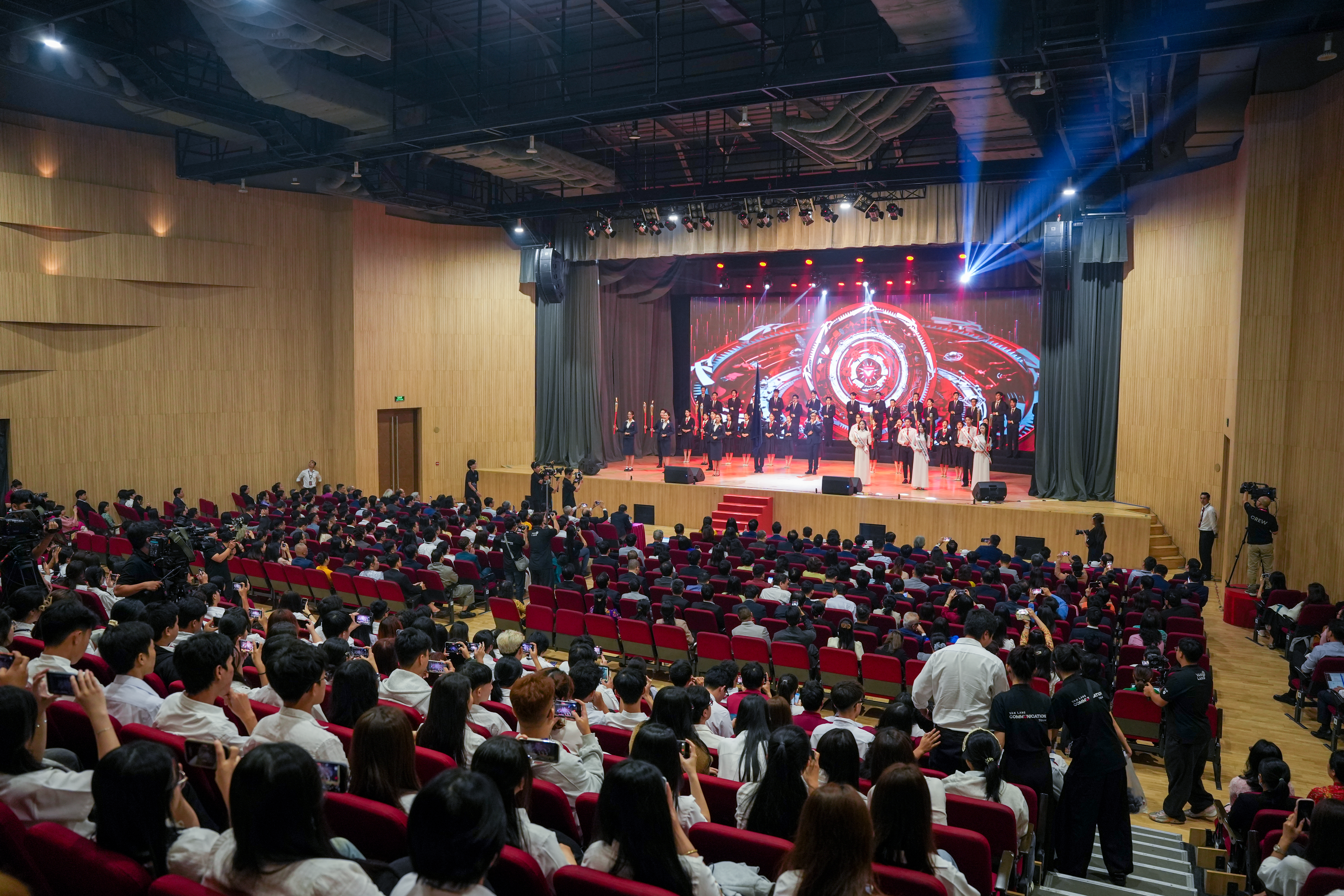
On the morning of September 26, 2026, Assoc. Prof. Dr. Tran Thi My Dieu - Member of the University Council, President of Van Lang University - sent a powerful message about the cultivation of independent thinking in the era of artificial intelligence at the Convocation Ceremony for Class 32. Commencing the university journey, each new student needs to contemplate the maturity in how we learn, how we think, and how we understand our surroundings.
Distinguished Ms. Bui Thi Van Anh, Secretary of the Party Committee and Chairwoman of the University Council of Van Lang University;
Distinguished members of the University Council, members of the Board of Directors, leaders of Faculties, Institutes, Centers and Departments, faculty members and staff;
Dear students of Class 32,
First of all, on behalf of the leadership of Van Lang University, I would like to extend my warmest welcome and best wishes for good health to our distinguished leaders, faculty members and staff, and to all students and new students joining us today for Van Lang University’s Convocation Ceremony for the 2026–2027 academic year.
Distinguished colleagues and dear new students,
This academic year, we are delighted to welcome you, the new students of Class 32, who have joined us from more than 1,500 high schools and educational institutions across the country. Forty percent of you graduated from high school with excellent academic results, and more than 400 have already achieved Level 4 out of 6 on Vietnam’s Foreign Language Proficiency Framework for English.
Each of you has come to Van Lang from a different place, bringing your own story, experiences, abilities and interests. It is precisely this diversity that will make Class 32 such a rich and vibrant community, where you will learn not only from your lecturers, but also from one another.
Alongside students enrolled in our standard programs, this year we also welcome many students to the Global Elite program, Global Standard, and Global Partnership, further enriching a learning community that continues to grow in the diversity of its aspirations and experiences.
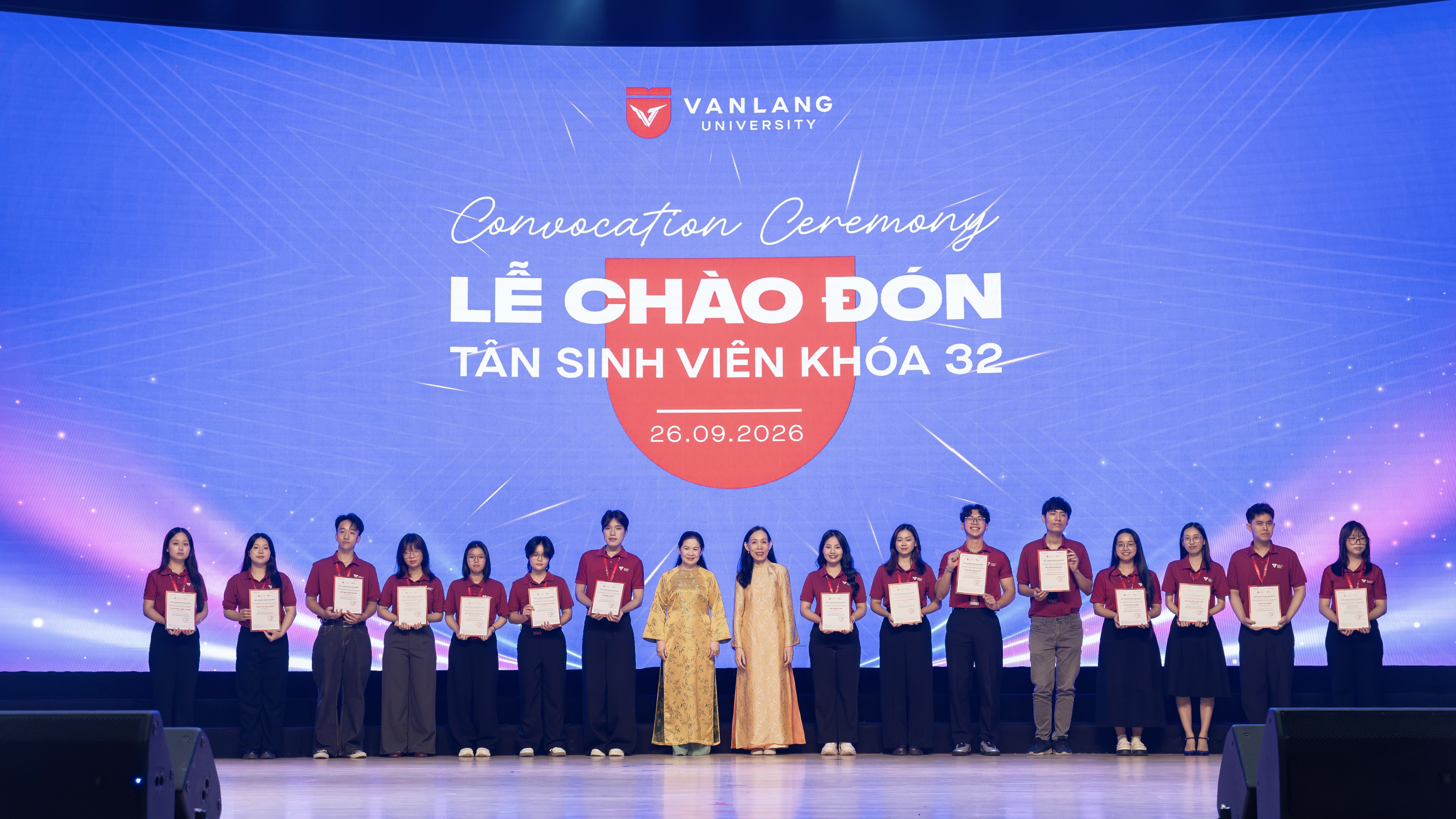
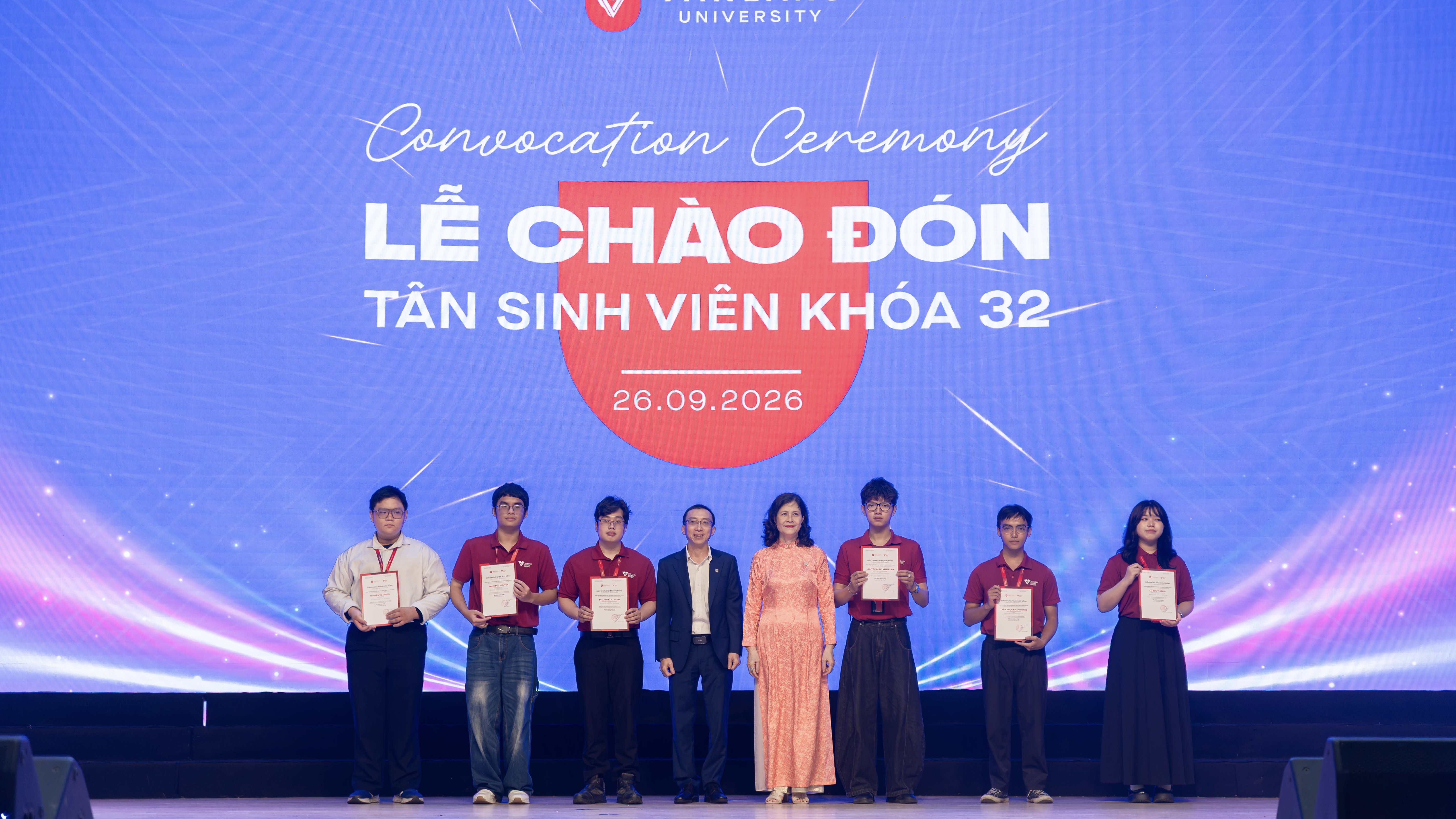
Among the new students of Class 32 receiving various forms of scholarship support this year, many students have been awarded Type 1 scholarships, equivalent to 60 percent of first-semester tuition fees. In particular, over 80 students have received Talent Scholarships and Elite Scholarships. These scholarships recognize outstanding achievement in academics, scientific research, technology, the arts, design, sports, entrepreneurship and leadership.
Congratulations to all of you. I hope these scholarships will encourage you to continue developing your abilities throughout your years at Van Lang.
The achievements you have already attained are a beginning worth celebrating. But from today onward, regardless of the accomplishments, experiences or starting points with which you enter Van Lang, all of you are beginning a new journey together. Ahead are many new things to learn and discover, challenges to overcome, and opportunities for each of you to continue growing.
On behalf of the University, I warmly welcome you as the newest members of the Van Lang community.


Dear students,
You have now begun the first few weeks of university life. After the initial unfamiliarity, perhaps you are gradually getting used to a new environment, new friends, new lecturers, new courses, and a rhythm of life very different from your years at school.
In my meetings with new students at the beginning of the academic year, I told you that university is not merely a period of study in preparation for a profession. It is also a process of personal growth and holistic development. Today, at this Convocation Ceremony for the new academic year, I would like us to reflect more deeply on one particularly important dimension of that growth: how we mature in the way we learn, the way we think, and the way we understand the world around us.
Throughout your school years, much of what you needed to learn was clearly defined. You had curricula, textbooks, teachers to guide you, assignments to complete, and examinations in which questions often had relatively clear answers. At university, learning gradually becomes different. You will not simply need to acquire more knowledge or find answers to more difficult problems. More importantly, you must gradually learn how to arrive at understanding for yourselves: how to ask questions, how to think, how to verify, how to evaluate and form judgments, and also how to recognize the limits of your own understanding.
This has become even more important in the world in which you live today. Never before have human beings had access to such an enormous volume of information. New technologies, particularly artificial intelligence, are helping us search for information, solve problems and obtain answers at a speed that would have been difficult to imagine only a few years ago. Yet precisely because answers are becoming easier to find, one fundamental question of education becomes even more important: Do we truly understand what we know, and how do we use our own minds in the face of all the information, answers and perspectives that the world places before us?
I believe this is one of the areas in which university education must help you mature. By the time you complete your years here, what matters is not simply that you know more than you do today, but that your way of thinking has matured: that you are able to investigate an issue thoroughly for yourselves; that you can think and form judgments of your own; and at the same time, that you remain open enough to recognize that your understanding will always have limits and that there will always be more to learn. This process does not take place within a single course or a single semester. It is shaped by everything you learn, every question you ask, every time you have to think through a difficult problem, every discussion with your lecturers and friends, and every moment when you realize that something you once believed to be correct may in fact have been incomplete.
Today, I would like to share three things that I believe are particularly important if you are to gradually develop such a way of thinking during your university years.
First: do not assume that having an answer means that you truly understand.
Think about a familiar situation. When you encounter a difficult lesson or problem that you do not understand, what do you usually do? You may read a textbook, ask your lecturers, discuss it with friends, or search online. Today, you also have access to an exceptionally powerful tool that previous generations of students never had: artificial intelligence.
Within seconds, AI can explain a concept, solve a problem, analyze an issue, or even produce a complete essay. Your generation has greater access to information and answers than any generation of students before you. But for precisely that reason, I want you to make a very clear distinction between two things that may appear similar: Having an answer is not the same as understanding. A solution may be right in front of you, but if you do not understand why it is correct, that knowledge has not truly become your own. An essay generated by AI may be highly coherent, but if you cannot explain its reasoning yourself, do not know what evidence supports it, and cannot evaluate which parts are reasonable and which may not be, then the capability demonstrated in that essay is still not your own capability.
The nature of learning does not change simply because technology changes. Learning remains a process of transforming our own understanding: from not knowing to knowing, from not understanding to understanding, from partial understanding to deeper understanding. And that process only truly takes place when our own minds are actively engaged. I have often reminded generations of students of this: we need to be honest with ourselves about whether we truly understand something, and we need the persistence to use our own minds to reach the heart of a problem. So when you encounter something you do not understand, do not be too quick to accept the first answer you find. Learn to ask further questions: Why is this so? What evidence supports this conclusion? Could there be another explanation? Can I explain this problem in my own words? These questions may seem simple. But if you practise asking them regularly, they will gradually change both the way you learn and the way you think.
Your lecturers can help you. Your friends can help you. Books, the Internet and AI can help you enormously. Make full use of all these resources. But there is one thing you should never hand over to another person or to any technology: the responsibility of using your own mind to think until you genuinely understand. Because the ultimate purpose of learning is not to accumulate as many answers as possible. It is to develop a mind that becomes increasingly capable of thinking, investigating, analyzing and solving problems independently.
Second: alongside learning to think for yourselves, you must also learn to examine, evaluate and draw your own conclusions. Do not be too quick to believe something simply because someone else says it is true.
This is especially important in today’s world.
Never before have we had such easy access to so much information. Every day, through social media, news outlets, digital platforms and AI, you encounter countless claims about society, economics, science, history, culture, careers, and even advice about what young people should study, what they should do and how they should live. The problem, therefore, is no longer a lack of information. The challenge is learning how, amid so much information and so many opinions, to determine what we have good reason to believe. What is true and what is false, what is well-founded and what is not, may appear side by side in forms that are equally convincing. An AI-generated answer may be presented clearly and confidently while still containing inaccurate information or arguments that require further verification.
In such a context, you need to cultivate the ability to examine, evaluate and form judgments for yourselves. When you read a piece of information, ask where it comes from. When you hear a claim, examine the evidence and reasoning that lead to that conclusion. When many people believe the same thing, remain calm enough to consider whether it is in fact reasonable. This is what I mean by independent thinking and critical thinking, concepts that I have discussed with students many times. Independent thinking does not mean that you must always disagree with others. Critical thinking also does not mean being suspicious of or rejecting everything. What matters is that you do not automatically accept something simply because a person, even a respected person, says it, because many people believe it, or because AI has produced that answer. Learn to pause, think, verify, and arrive at your own conclusions on reasonable grounds.
In the age of AI, this is perhaps more important than ever. In the past, a passive learner might have depended excessively on teachers, textbooks or prepared answers. Today, it is just as easy to become dependent on intelligent technology. If we continue to allow someone else, or some tool, to think and draw conclusions on our behalf, then the essential nature of that passivity has not changed. I hope you will remain constantly aware of this: whatever tools you use, in the end, it is you who must use your own minds to think and form judgments of your own.

Third: always remain conscious of the limits of your own understanding.
Once you have learned to think for yourselves and form your own judgments, there is one further quality I hope you will cultivate throughout your university years: the awareness that every person’s knowledge is limited, and that our judgments may always be wrong or incomplete. The more deeply we learn, the more we realize that beyond what we already know lies an enormous amount that we do not know. There are questions for which evidence remains incomplete. There are scientific problems that researchers are still working to solve. There are things we once believed to be true that may need to be reconsidered when better evidence emerges. But I would like you to take this idea one step further. There are things we do not know, and we know that we do not know them. But there are also things that we do not even know that we do not know - the “unknown unknowns.”
When we know that we do not understand something, at least we can see the gap in our knowledge. We can ask questions, find books to read, consult our lecturers, or search for further information. What is more difficult are those things that lie entirely outside the boundaries of our current understanding. Because we are not even aware of their existence, we do not yet know what questions to ask.
You may already have experienced, or may one day experience, something like this. You spend a long time thinking about a problem and believe that you have considered it quite thoroughly. Then, in a conversation, someone asks a question that has never occurred to you before, and suddenly your entire way of seeing the problem changes. It is not simply that we do not know the answer to this new question. We did not even know that such a question needed to be asked. The same is true in learning and research. Sometimes the most important progress does not come from finding a better answer to an existing question, but from recognizing that there is another, more important question that should be asked, one that we had never previously thought of.
A mature mind, therefore, must not only learn how to ask good questions. It must also remain aware that there may be questions that it does not yet know how to ask. This awareness does not mean doubting everything or doubting ourselves. On the contrary, it requires us to be honest enough to distinguish between what we know, what we do not know, and what we do not yet have sufficient grounds to conclude. It requires us to be confident enough to think independently and reach our own conclusions, while also being humble enough to say: “I do not know.” “I may be wrong.” And to be willing to change our minds when better evidence becomes available. And if we understand that there may be things we do not even know that we do not know, then we have even more reason to keep our minds open. Learn about things beyond the areas that already interest you. Listen to people whose knowledge and experiences differ from your own. Engage with different disciplines, cultures and perspectives. Sometimes it is precisely through such encounters that we begin to see things that, from our own position, we did not even know were there to be seen.
During your years at Van Lang, I hope you will gradually cultivate this attitude. Try to understand deeply what you learn. Have the courage to use your own minds to think and form judgments of your own. But at the same time, remain aware that there are things you do not know and, more importantly, that there may be many things you do not yet know that you do not know. That awareness will help you remain curious, continue asking questions, and keep expanding the boundaries of your understanding. The more we learn, the more we do not simply know more; we also begin to realize how much larger the world is than what we already understand. That is one of the most important signs of intellectual maturity that higher education can help us develop.

Dear students,
Everything I have shared with you today revolves around something that I believe is fundamental to your university years: you must gradually become active participants in your own learning and in your own development. Learn with your own minds, learn to think and form judgments for yourselves, but at the same time remain conscious of the limits of your understanding, so that you preserve your curiosity, your openness and your readiness to continue learning.
But your university journey will certainly involve much more than classes, assignments and examinations. I hope that the years ahead at Van Lang will become a rich, vivid and rewarding journey for each of you. Study seriously, but also step beyond the classroom to discover new things; take part in activities that genuinely interest you; meet and work with people who are different from you; learn more about society, culture and the world around you; and make full use of the opportunities for research, creativity, internships, community engagement and international exchange that may come your way in the years ahead. Along this journey, there will be things you do well and things you do less well; there will be good choices and times when you need to change direction; and there will be things you believe you understand today that, a few years from now, you may look back upon in an entirely different way. Do not be afraid of any of this. Because growing up does not mean knowing from the very beginning exactly where you should go or what you should do. It means developing the capacity to keep learning, thinking, choosing and adjusting throughout the journey.

University will provide an environment and opportunities for learning, research and experience. Your lecturers will teach, guide and accompany you. Your friends will share these very special years with you. Technology will place increasingly powerful tools in your hands. But in the end, no one can learn for you, no one can think for you, no one can experience life for you, and no one can grow on your behalf. That is why I hope you will approach the university years ahead with a truly proactive mindset. Do not limit learning to what is required in a course or what is necessary for an examination. Look more widely, ask more questions, explore more deeply, engage with things you do not yet know, and be willing to challenge yourselves through new opportunities. Use these years to broaden your understanding of your chosen field, of the world, of the people around you, and also of yourselves.
Four, five or six years of university will pass very quickly. When you return to this hall on your graduation day, I hope that what you carry with you will be more than a degree and professional knowledge. I hope you will be able to look back on a university journey rich in experience, broader in understanding, and genuinely transformative; so that when you leave Van Lang, you will be more independent in your thinking, more grounded in character, capable of continuing to learn, and confident enough to step into a world that will continue to change.
University is only one stage in a much longer journey of learning and growth. But these are particularly important years in which you will build the foundations for that journey. Enter it with the curiosity of someone who genuinely wants to understand, the openness of someone who knows that there is still so much they do not know, and the courage to try, to change, and to keep moving forward.
I wish you university years filled with energy, discovery, experience and joy, a journey that you yourselves take an active role in creating.
I wish all our distinguished faculty members, staff and students good health, peace and happiness. May the new academic year be filled with energy and success.
Thank you very much.
My Dieu
26.09.2026
Tags
