
Faculty of Accounting and Auditing, Van Lang University: Addressing “Fair Value” Measurement Challenges in the IFRS Adoption Journey


On the afternoon of August 8 2026, Faculty of Accounting and Auditing, Van Lang University, organized an in-depth academic workshop titled “Do luong gia tri hop ly trong Ke toan quoc te va thuc tien ap dung tai Viet Nam” (Fair value measurement in international Accounting and its practical application in Vietnam). As Vietnam actively advances the adoption of International Financial Reporting Standards (IFRS), the shift from “historical cost” basis to “fair value” measurement has become an increasingly important requirement for professionals in the Finance and Accounting sector.

When “fair value” becomes a measure of financial transparency
Serving as the keynote speaker at the workshop, Dr. Hoang Thuy Dieu Linh, lecturer at Faculty of Accounting and Auditing, emphasized that in modern international accounting, the fair value principle plays a key role in providing a faithful and timely representation of a company’s financial position under market conditions.
According to her, while traditional accounting has typically relied on the initial transaction price, under IFRS 13, fair value is defined as an “exit price”- the price that would be received as in selling an asset or transferring a liability in an orderly transaction among market participants at the measurement date.

The discussion focused on the key technical areas of IFRS 13, including:
“Highest and best use” principle: Applied to non-financial assets based on three criteria: physically possible, legally permissible, and financially feasible.
Fair value hierarchy: Ranging from Level 1 (quoted prices in active markets), Level 2 (observable inputs), to Level 3 (unobservable inputs that require companies to use reliable internal valuation models).
Interstandard relationships: The close relationship between IFRS 13 and other standards, including IAS 16 (Property, Plant and Equipment), IAS 40 (Investment Property), IAS 41 (Agriculture), and IFRS 9 (Financial Instruments).
Practical comparison: The gap between IFRS and Vietnamese accounting regulations
One of the most engaging parts of the workshop was the comparison between international standards and the current legal framework in Vietnam (Accounting Law No. 88/2015/QH13 and Circular No. 99/2025/TT-BTC).
Ms. Thuy Linh pointed out that in Vietnam, fair value is currently applied mainly at the initial recognition stage or when assets and liabilities are sold or settled. Periodic remeasurement at the financial reporting date has yet to be widely adopted due to limitations related to market liquidity and the availability of market data. Understanding these differences helps students develop stronger critical thinking skills and prepare to adapt to the ongoing transition toward IFRS/VFRS among Vietnamese.

Industry-connected education: Elevating next generation of accounting professionals
The open discussion took place in a lively atmosphere, with students raising a wide range of questions about topics such as building Level 3 valuation models, responding to significant market fluctuations, and pathways to obtaining international professional certifications. The speaker provided detailed and thoughtful answers to each question.
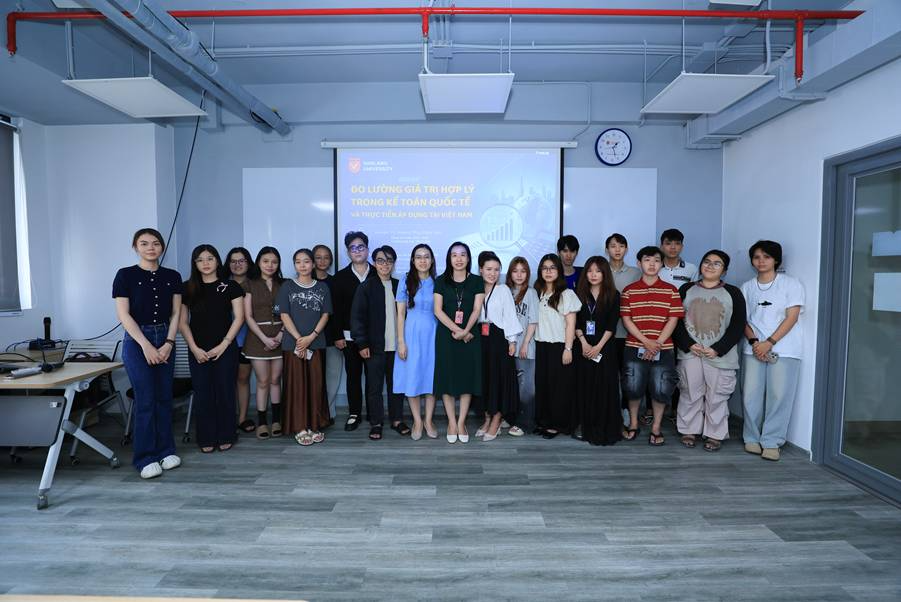
The workshop concluded with valuable practical insights for students. More than just a quality academic forum, this workshop reaffirmed Faculty of Accounting and Auditing’s commitment to continuously enhancing its curriculum, bringing international accounting standards into the classroom, and building a strong foundation for the next generation of Finance and Accounting professionals.
News & Photos: Faculty of Accounting and Auditing
Tags
