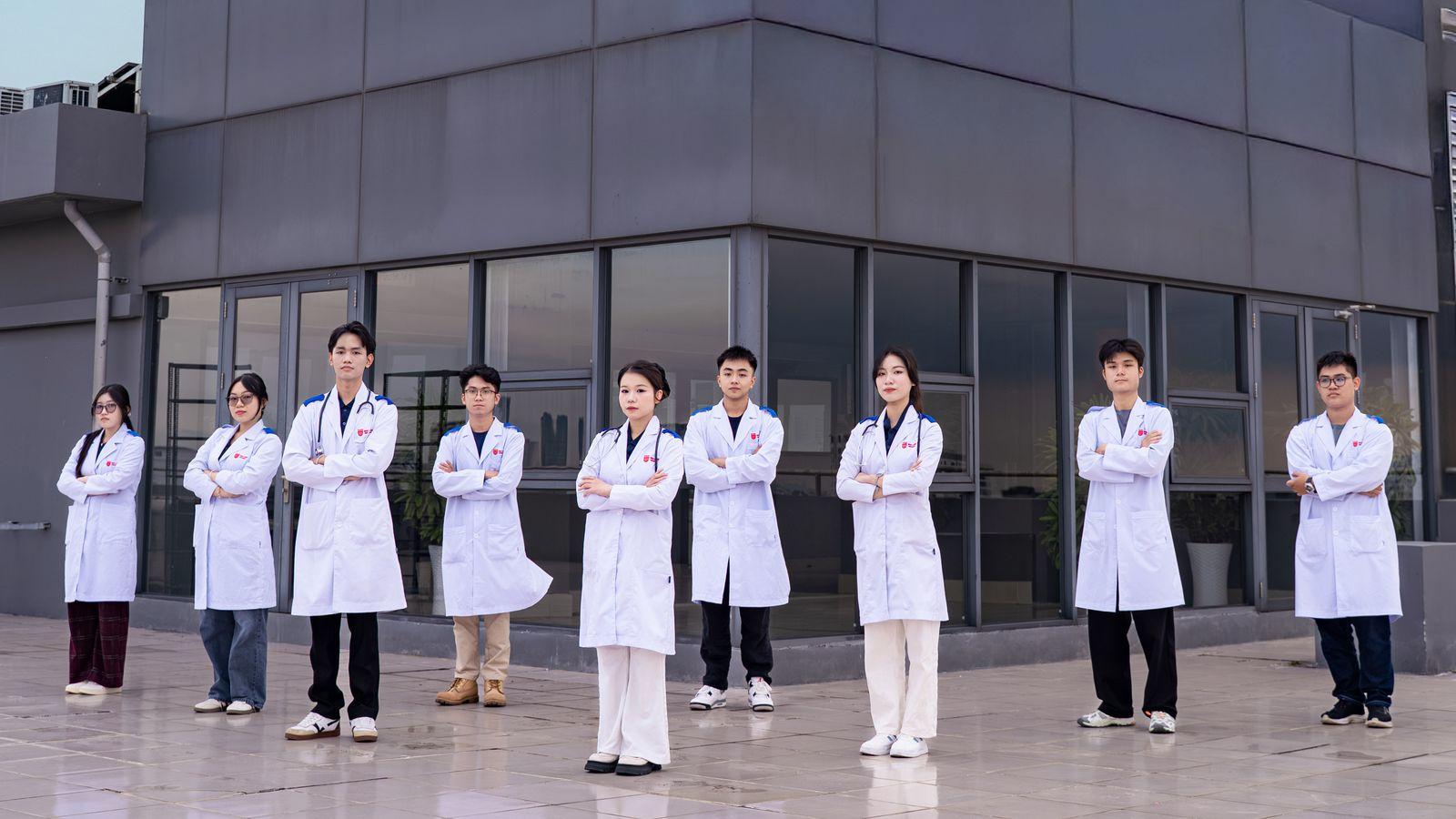
Doctor

Degree

Doctor
Doctor of Medicine

Study Mode

Full-time

Major Code

7720101

Intake Period

08/2026

Duration

6 years

Admission Subject Combinations

A00: Mathematics - Physics - Chemistry
B00: Mathematics - Chemistry - Biology
D07: Mathematics - Chemistry - English
X09: Mathematics - Chemistry - Economic and Legal Education
X10: Mathematics - Chemistry - Informatics

Campus

Campus 2, 233A Phan Van Tri Street, Binh Loi Trung Ward, Ho Chi Minh City

Overview

A promising field of study with increasing workforce demand

A promising field of study with increasing workforce demand

The major meets the high demand of the healthcare system, offering stable employment opportunities and long-term career development in the future.

A promising field of study with increasing workforce demand
Digital Doctor Program - studying medicine in the digital era

Digital Doctor Program - studying medicine in the digital era

Applying digital transformation in teaching, enabling students to access modern medical technologies from their time in the classroom.

Digital Doctor Program - studying medicine in the digital era
Studying with leading medical doctors

Studying with leading medical doctors

Learning process is closely guided by experienced medical doctors, enabling students to gain in-depth knowledge and strong professional competence.

Studying with leading medical doctors
Clinical internships at leading reputable hospitals in Viet Nam

Clinical internships at leading reputable hospitals in Viet Nam

Students undertake practical training at reputable hospitals, developing hands-on clinical skills.

Clinical internships at leading reputable hospitals in Viet Nam
A modern and comprehensive facilities ecosystem

A modern and comprehensive facilities ecosystem

Medical training system under Government Decree 111/2017/ND-CP with major partner hospitals such as Gia Dinh People’s Hospital (main training site), Military Hospital 175, 30-4, Nguyen Trai, Trung Vuong, Oncology, Hung Vuong and Children’s Hospital 2; Medical Skills Training Center (OSCE rooms, ICU, 370+ models), VLMC clinic, basic medical labs and modern student facilities.

A modern and comprehensive facilities ecosystem

Program Highlights

A comprehensive healthcare education ecosystem

The medical learning environment is an interdisciplinary and systematic space.

Digital simulation and practice

Equipped with digital technologies from patient intake to diagnosis and treatment.

Continuous clinical exposure throughout the program

Enabling learners to become familiar with the pressure and real-life pace of the medical profession.

Substantive international engagement

Providing learners with a network that connects them to advanced healthcare systems worldwide.

Program Structure

Fundamental knowledge of the field

  • Medical Biophysics
  • General Chemistry
  • Biology and Genetics
  • Cell and Molecular Biology
  • Medical Microbiology and Parasitology 1
  • Medical Microbiology and Parasitology 2
  • Medical Psychology and Ethics

Fundamental knowledge of the field

  • Anatomy 1
  • Anatomy 2
  • Medical Biochemistry
  • Histology
  • General Embryology
  • Basic Nursing
  • Physiology 1
  • Physiology 2
  • Pathophysiology - Immunology
  • Pathological Anatomy
  • Symptomatology
  • General Pharmacology
  • Clinical Pharmacology
  • Medical Skills 1
  • Medical Skills 2
  • Medical Skills 3

Internal Medicine

  • Internal Medicine Pathology 1
  • Internal Medicine Pathology 1 Practice
  • Internal Medicine Pathology 2
  • Internal Medicine Pathology 2 Practice
  • Internal Medicine Treatment
  • Internal Medicine Treatment Practice

Surgery

  • Basic Surgery
  • Basic Surgery Internship
  • Pathological Surgery 1
  • Pathological Surgery Internship 1
  • Pathological Surgery 2
  • Pathological Surgery Internship 2

Obstetrics

  • Obstetrics and Gynecology 1
  • Obstetrics and Gynecology Internship 1
  • Obstetrics and Gynecology 2
  • Obstetrics and Gynecology Internship 2

Pediatrics

  • Pediatrics 1
  • Pediatrics 1 Internship
  • Pediatrics 2
  • Pediatrics 2 Internship

Community Medicine

  • Health Communication and Education
  • Scientific Research Methods
  • Epidemiology - Demography
  • Community Practice
  • Healthcare Management and Organization
  • Health Economics - Communication and Occupational Health
  • Nutrition and Food Safety
  • Health Economics - Health Insurance
  • Hospital Management

Other Specialties (Specialties)

  • Infection Control
  • Traditional Medicine
  • Diagnostic Imaging
  • Anesthesiology and Resuscitation
  • Psychiatry
  • Infectious Diseases
  • Dermatology
  • Geriatrics
  • Geriatrics
  • Emergency Resuscitation
  • Oncology
  • Neurology
  • Ophthalmology
  • Rehabilitation
  • Forensic Medicine
  • Ear, Nose and Throat (Otorhinolaryngology)
  • Dentistry
  • Family Medicine
  • Orthopedic Surgery
  • Geriatrics, Chronic Diseases and Disabilities
  • Hematology and Blood Transfusion
  • Nuclear Medicine
  • 8 English courses accredited by NEAS (Australia), ensuring the exit requirement equivalent to IELTS 6.0
  • Graduation Thesis
  • 8 general education courses

Learning, Teaching & Assessment Methods

Methodology Overview

(connected with diverse experiences, connected with practice, comprehensive development)

  • Studying theory combined with practice oriented toward high professional specialization.
  • Conducting medical research through practical models and projects.
  • Closely integrating professional skills with practical simulation.
  • Integrated learning of technology toward digital transformation in Medicine.
VLU_8359-Enhanced-NR.JPG

Program Learning Outcomes

  • Problem-Based Learning (PBL): Students discuss in small groups to solve hypothetical clinical cases, identify knowledge gaps, and find solutions under the guidance of a facilitator.
  • Team-Based Learning (TBL): The process involves individual preparation, readiness assessment, and applying knowledge to solve real-world situations with teammates in class.
  • Competency-Based Medical Education (CBME): Focuses on achieving specific skills, allowing students to progress at their own pace.
  • Entrustable Professional Activities (EPAs): The program is divided into specific clinical tasks (such as prescribing medication or taking patient history); instructors assess student independence at each stage.
  • Horizontal and Vertical Integration: Combining foundational subjects (horizontal) and integrating clinical knowledge from the early years (vertical) to help students understand the practical application of theory.
  • Flipped Classroom: Moving theoretical learning outside of class hours via video or readings; in-person time is dedicated to in-depth discussion, debate, and addressing professional questions.
  • Evidence-Based Medicine (EBM): Teaching methods for searching, critically evaluating, and applying the latest scientific research evidence to the diagnosis and treatment of patients.
  • High-Fidelity Simulation: Using lifelike, physiologically responsive robots to practice emergency response, minimizing medical errors in real-world scenarios.
  • Service-Learning: Combining professional training with community health projects, helping students develop medical ethics and understand the social factors influencing disease.
  • e-Portfolio: Students can store evidence of their learning progress, faculty feedback, and certifications to self-assess and guide their career development.

Multimodal Learning Approaches

The program's output competencies are built upon the "Basic Competency Standards for General Practitioners" issued under Decision No. 1854/QD-BYT dated May 18, 2015, by the Minister of Health, comprising 90 criteria focusing on 4 areas:

AREA 1: PROFESSIONAL PRACTICE COMPETENCE

Medical doctors must practice professionally according to ethical and legal standards and respect diverse cultural values.

AREA 2: APPLICATION OF MEDICAL KNOWLEDGE

Medical physicians must be able to apply knowledge from basic medical sciences, pathology, and medical sociology as a theoretical basis to identify, explain, and solve problems, and to communicate information about health conditions and diseases to individuals, groups of individuals, and communities.

AREA 3: MEDICAL CARE COMPETENCE

Medical physicians must be able to address basic healthcare needs safely, promptly, cost-effectively, and based on scientific evidence and in accordance with practical conditions.

AREA 4: COMMUNICATION AND COLLABORATION SKILLS

Medical doctors must be able to communicate effectively with patients, their families, colleagues, and the community.

Learning and Practice Facilities

Innovation Center

Modern learning spaces and diverse practice environments help students develop professional skills and prepare for real-world work.

15+

Functional labs for unlimited learning

Medical practice area

Students engage in continuous practice, directly experiencing vital signs measurement on simulation models and cardiopulmonary resuscitation (CPR) techniques at the Medical practice area.

Medical Skills Center (MSC)

Van Lang University has invested more than 2 million USD to build the Medical Skills Center with an area of over 1,000 m². The Center includes 6 OSCE rooms, an ICU room, a clinical skills training room, a simulated patient area, and a clinical simulation equipment system. It is equipped with more than 370 practice models, categorized into 112 types and eight specialty groups, along with audiovisual systems and medical equipment that meet international standards.

VLMC Polyclinic - School-Hospital model

In addition to specialized practice facilities for each major, Van Lang Education Group invests in and operates the VLMC Polyclinic located on campus. It serves as a real-world clinical practice site for students, gradually advancing toward a school-hospital model in the near future.

Auditorium

Built to international standards with approximately 1.600 seats, fully equipped with advanced facilities, and featuring floors and walls constructed entirely with soundproof wood.

HUB

A place where students can seek support for academic-related matters.

Faculty

Alumni Community

440+

Graduates

1500+

Current Students

93%

Employed within 1 year of graduation

Career Opportunities

Students are equipped with a solid foundation to confidently pursue careers in the fields of healthcare and health services:

  • Participating in a 12-month internship program and taking the Medical Practice License Examination

Working within healthcare systems:

  • Hospitals, International and Private Clinics
  • Public Hospitals
  • Medical Centers, Community Health Stations

Working in educational and research institutions:

  • Teaching Assistants/Lecturers at Colleges and Universities offering Health Sciences programs
  • Researchers at Institutes or Healthcare Research Centers

Continuing advanced academic pathways:

  • Resident Doctor
  • Master’s Degree
  • Doctoral Degree (PhD)
  • Specialist Level I
  • Specialist Level II

Scholarship Program Tuition

An investment of 200 - 250 million VND for the entire course at Van Lang is how you take control of your future path with transparency in an international-standard ecosystem. This is a worthy investment to unlock your potential in a modern environment, ready to become a global citizen.

Van Lang Talent Scholarship

300 talent scholarships worth 25 - 100 million VND, for students with outstanding achievements in various fields. Scholarships accompanying female students. Scholarships accompanying education majors.

Official information will be announced on the Van Lang University website in March 2026.

Admission Requirements

In 2026, you can apply for admission to Van Lang University using 06 methods

  • 2026 VNU Competency Assessment Exam Results; 
  • 2026 University Entrance Competency Assessment (V-SAT) Exam Results; 
  • 2026 Hanoi University of Science and Technology Thinking Assessment Exam Results; 
  • International Certificate Exam Scores (SAT, IELTS, TOEFL iBT).

Thông tin

Experiential events

Which experiential event would you like to join at Van Lang?

Join Discovery Day VLU

Select province
Search or select school
Select class

What would you like to learn? Choose 2 things you care about most*

Experiential events

Which experiential event would you like to join at Van Lang?

Chọn sự kiện

Join Discovery Day VLU

Experiential events

Select province
Search or select school
Select class

What would you like to learn? Choose 2 things you care about most*